Rated 4.7 out of 5 stars
4.7 / 5


726,000+ customers
Free 60-Day Returns
1-Year Warranty
726,000+ customers
Free 60-Day Returns
1-Year Warranty
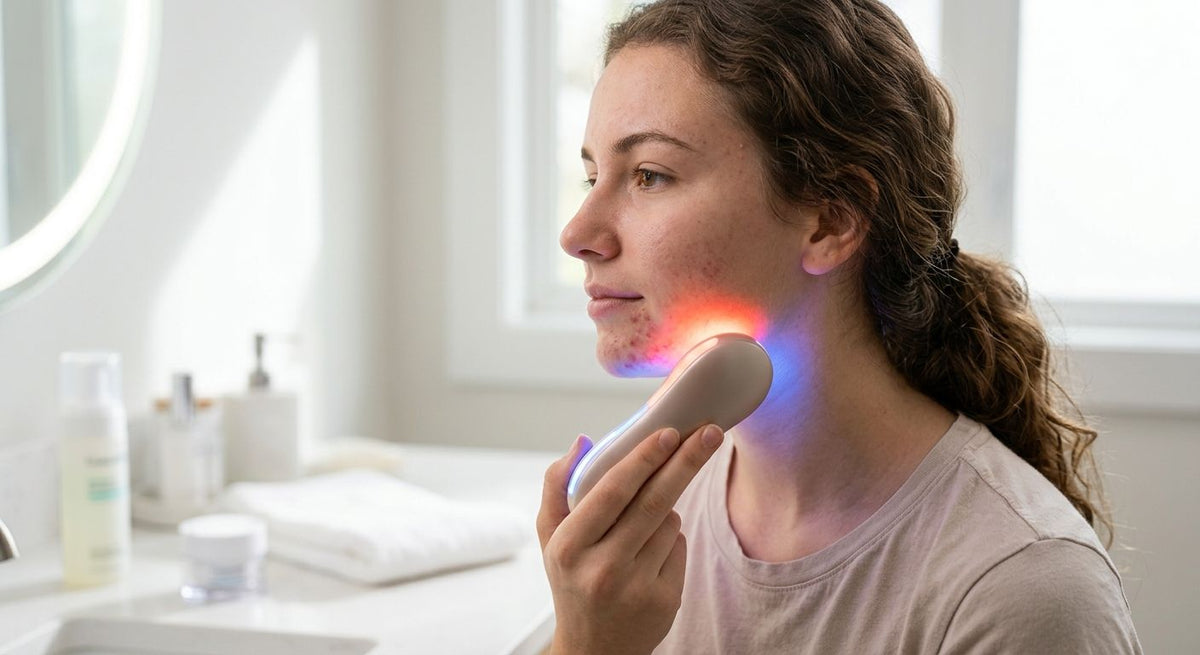
Use blue light first to hit the acne-causing bacteria sitting on active breakouts, then immediately follow with red light to calm the inflammation and redness those breakouts leave behind — running both wavelengths in the same session, several times a week, works faster than either light alone in 2026. The catch most guides skip: blue light does nothing for the post-breakout redness and texture damage, and red light alone won't touch active bacteria, so skipping either step leaves half the problem untreated.
Acne isn't one problem, it's two stacked on top of each other: active bacteria causing new breakouts, and inflamed, damaged tissue left behind by the breakouts you already had. Treating only one half explains why a lot of at-home routines plateau in 2026. A 4-in-1 Radiant Renewal skincare wand covers the red light half of that equation for face, neck, and jawline, but it's the pairing with blue light — not red light alone — that addresses both the bacteria and the aftermath in the same routine.
Most dermatology-adjacent guidance frames blue light as the anti-bacterial step and red light as the recovery step. Running them back-to-back is standard advice precisely because the two do different jobs rather than overlapping ones.
The verdict: blue light on the spots, red light on the whole face, in that order, 3 to 5 times a week — that is the combined protocol worth running in 2026.


| Blue light | Red light | |
|---|---|---|
| Studied range | Roughly 405-420nm | Roughly 630-660nm |
| Main job for acne | Targets acne-causing bacteria | Calms inflammation, supports healing |
| Where to use it | Directly on active breakouts | Across the full face |
| Order in session | First | Second |
| Pro | Works at the bacterial source | Addresses redness and post-breakout skin |
| Con | Does nothing for lingering redness | Won't clear active bacteria on its own |
| Best for | New, inflamed spots | Post-breakout redness and texture |
Both steps take a single session. Neither replaces the other, and running only one is why plenty of people conclude "light therapy didn't work for my acne" in 2026.
“Blue light handles the bacteria on the surface; red light handles the inflammation underneath. Skip one and you're only treating half the acne cycle.”
Yes — using red and blue light on the same day, back-to-back in one session, is the standard approach rather than alternating them on separate days. Doing them together lets the anti-bacterial and anti-inflammatory effects work in sequence instead of leaving a gap where bacteria regroup.
Neither wins alone: blue light is better for active bacterial breakouts, red light is better for the redness and healing that follows, and combining them outperforms using just one. Relying on red light alone tends to leave active breakouts untreated at the source.
Most people who stick with 3 to 5 sessions a week report noticeable changes somewhere between 4 and 8 weeks, not after a single session. Results plateau fastest for people who skip weeks rather than for people who run a slightly shorter session.
For breakouts specifically tied to hormones rather than surface bacteria, the combined-light approach still helps with inflammation, but pairing it with guidance on red light therapy for hormonal acne closes gaps that light alone won't cover.
What's the best way to combine red and blue light for acne?
Cleanse first, run blue light directly on active breakouts, then immediately follow with red light over the full face, 3 to 5 times a week. Skipping the cleanse step or rushing the order reduces how much light actually reaches the skin.
Is red and blue light therapy better than benzoyl peroxide for acne?
They work on different mechanisms and aren't direct substitutes — blue light targets bacteria without the drying side effects some people get from benzoyl peroxide, while red light adds an anti-inflammatory step benzoyl peroxide doesn't offer. Many routines use both rather than choosing one over the other.
How often should you use red and blue light together for acne?
3 to 5 sessions a week is the common cadence, not daily use for most people. Daily sessions aren't required for the combined approach to work, and overuse of blue light in particular can leave skin drier than intended.
Can red and blue light therapy cause purging?
Some people notice a short adjustment period as skin turnover speeds up, but this settles within the first couple of weeks for most users. Reducing frequency rather than stopping altogether usually resolves early irritation.
Does red and blue light therapy work on cystic acne?
Light therapy can reduce inflammation around cystic breakouts, but cystic acne generally needs a dermatologist involved alongside any at-home light routine. Treating cystic acne with light alone tends to underdeliver compared to milder surface breakouts.
Can you use red and blue light therapy with retinol?
Yes, but most routines separate them by time of day rather than layering both at once, since retinol can increase sensitivity. Using light therapy in the morning and retinol at night is the more common split.
Do you need a serum to use with red and blue light therapy?
A serum isn't required for the light itself to work, but applying one after the session — not before — helps lock in hydration once treatment is done. Applying serum before the session can block light penetration.
How long should each light therapy session last for acne?
Follow the session length in your specific device's instructions rather than a generic number, since output differs between wands and masks. Longer sessions do not compensate for skipping days.
The order matters more than most people assume. Running red light before blue light instead of after doesn't ruin the routine, but it means the anti-bacterial step lands on skin that's already warmed and more reactive, which is a bad trade for sensitive skin. And if breakouts cluster along the jawline rather than the cheeks or forehead, the trigger is often hormonal — light therapy still calms the inflammation, but the cause needs separate attention. Solawave's red light therapy devices cover the red light half of the protocol; the blue light step needs a device that emits that wavelength.
 Acne
Acne